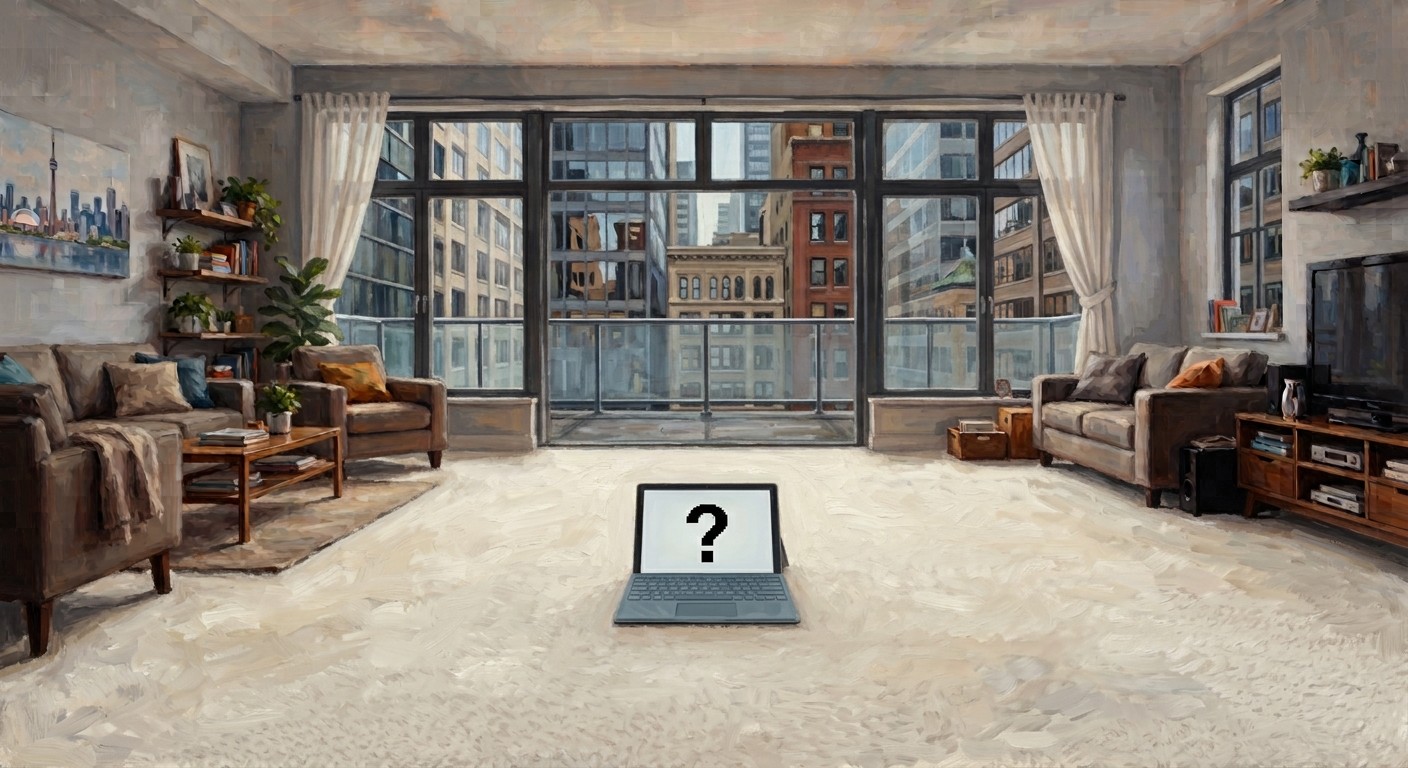
“I am having a flooring guy come on Monday and replace my carpets with hardwood floors. Can you please move my furniture and other items that exist there out so the flooring guy is unencumbered in his task?”
I asked AI a simple question.
Just like most times I interact with AI, it's to ask a simple question. Well, maybe not always simple, but a question that it seems to answer pretty instantaneously. As if it had the entirety of human knowledge indexed, understood, and ready to provide. And, in a lot of cases, it does. But today I asked it something as a joke. I asked it to move furniture.
I didn't quite know what to expect — a polite refusal, a suggestion to hire a professional moving service, or maybe a witty remark about my lack of physical form. But before I could further contemplate the response, it came:
That interaction left me staring at the screen, half-laughing and half-philosophical. It feels like we are living in an era where artificial intelligence can seemingly do everything. It can diagnose medical conditions, compose symphonies, write legal briefs, and generate photorealistic images of cats wearing spacesuits. Yet, here I was, stuck with a couch that needed to be moved by human hands, proving that despite the hype, there are still very real, very physical limits to what machines can do.
The physical limit of the digital mind
This disconnect highlights a fascinating paradox in our relationship with technology. We often speak of AI as if it is capable of reshaping reality. But the truth is, AI is incredibly powerful within the digital realm but completely helpless in the physical one. It can simulate a million scenarios for moving a sofa, but it cannot push the sofa itself. There is a distinct boundary between the cognitive and the corporeal.
While AI has undoubtedly disrupted industries reliant on data processing and pattern recognition, the physical world remains stubbornly resistant to automation. From plumbing to carpentry, from nursing to construction, the "last mile" of many jobs requires dexterity, adaptability, and a physical presence that robots — and certainly large language models — have yet to master. The contractors replacing my carpet weren't just installing wood; they were navigating uneven floors, dealing with dust, making on-the-fly adjustments, and physically hauling materials. That is a job for a human, or at least, a very advanced robot that doesn't exist yet.
The creative renaissance, not the replacement
However, this limitation shouldn't be seen as a failure of AI, but rather as a clarification of its role. While AI cannot move furniture, it has fundamentally changed the landscape for creative professionals. Contrary to the fear that AI would render artists, writers, and designers obsolete, evidence suggests the opposite is happening: creatives are becoming more productive than ever.
A significant study by researchers at MIT and Boston University, published in the National Bureau of Economic Research (NBER), found that customer support agents using generative AI resolved issues faster and with higher quality than those who didn't. But perhaps more relevant to our context is the broader trend observed across creative sectors. When AI handles the drudgery — the initial brainstorming, the first draft, the tedious formatting, the basic image generation — it frees up human minds to focus on strategy, nuance, and high-level creativity.
In my own work, I use AI to edit my content for spelling, grammar, and make sure it aligns with my own brand guidelines without replacing my voice; instead I hope it amplifies it. It allows me to iterate faster, explore ideas I wouldn't have had the energy to pursue, and refine my message with greater precision. The result isn't less human output; it's more. The barrier to entry for creating high-quality content has lowered, but the ceiling for what a single person can achieve has risen dramatically. We are moving from an age of scarcity, where time was the limiting factor, to an age of abundance, where the bottleneck is no longer production, but curation and vision.
The human touch in a digital world
So, as I watched the contractors haul in their equipment and begin the dusty, noisy, very physical work of transforming my floor, I felt a renewed sense of appreciation for the human element. AI can write the story about the renovation, but it can't feel the smooth grain of the new oak underfoot. It can generate an image of a perfect living room, but it can't smell the sawdust and the fresh finish. It can optimize the workflow, but it can't do the work.
We are entering a future where the most valuable skills might not be the ones AI can replicate, but the ones it cannot. Empathy, physical adaptability, complex problem-solving in messy environments, and the unique spark of human creativity are becoming our superpowers. AI is the ultimate tool, a lever that allows us to move mountains of data, but we still need to be the ones pushing the stone.
And honestly, if AI ever does figure out how to move furniture, I hope it starts with the heavy lifting and leaves the dust-busting to us. Or better yet, maybe it can finally teach my sofa to walk itself to the hallway. Until then, I suppose I'll stick to hiring humans for the heavy stuff and letting AI handle the words.
After all, if AI ever gets strong enough to move my couch, I'm pretty sure it'll be asking for a raise!

A story with a photo
Use this block when one tall photo belongs next to the words. Edit the text, then swap in your own photo and caption.