“Add a quote here.”
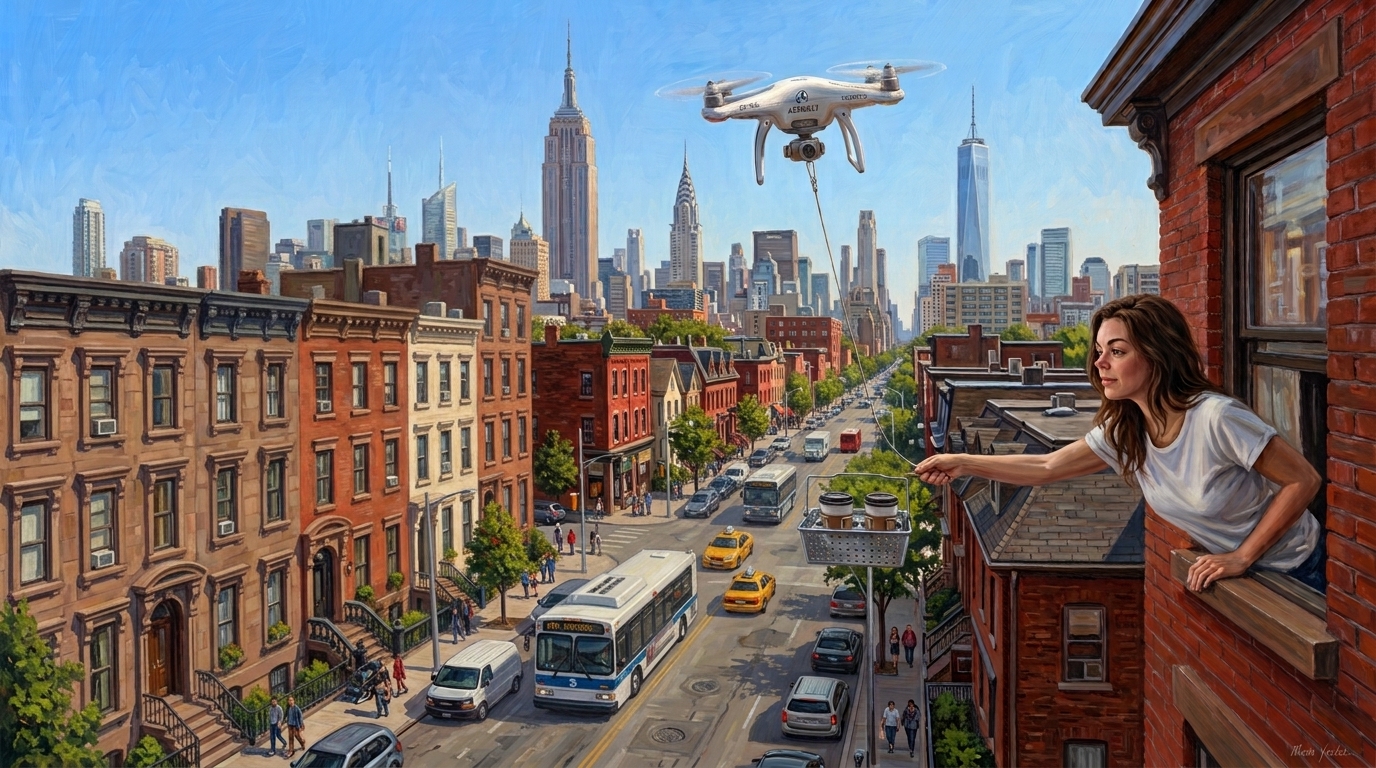
Where is our drone coffee?
When I speak about Flyhound, I often do so mentioning lives that can be saved, response time of public safety agencies, and crimes that can be solved. It prides me to do something with technology that can have a real impact. My partner, on the other hand, has a different idea entirely when it comes to drones.
Every morning when she wakes up, eyes pushing themselves awake, she stretches her legs and her first words are often "where is our drone coffee?"
It's a fair question. And honestly, it's the question a lot of people ask about drones — not "how will this help society?" but "when can it bring me a flat white?" There's something wonderfully democratic about that instinct. Public safety drone work is transformative, but drone coffee is relatable. It's the version of this technology that everyone can picture, which is precisely why the gap between the imaginary and the real bothers people so much.
Drone coffee is one use case among hundreds
When I talk to people outside the industry, I'm always struck by how narrow the mental picture of a drone is. For some it's a military tool, for others a hobbyist's toy, and for my partner, a caffeinated butler that has yet to materialise. The truth is that drone delivery and public safety are just two of many use cases that drones have already proven themselves in — agriculture, infrastructure and bridge inspection, powerline stringing, aerial surveying and mapping, film production, wildlife monitoring, warehouse inventory scanning, and medical sample transport between hospitals and labs, to name a few.
Each of those use cases faces the same fundamental hurdle as drone coffee, by the way, and it's worth naming it plainly because it explains everything that follows.
The rest of the world already gets drone deliveries
Here's the part that stings a bit if you're American: drone delivery isn't science fiction. It's a Tuesday morning in Norway.
My friend Lars Erik runs Aviant, a Norwegian drone delivery company. Through their delivery network they're moving parcels across the Nordics — medicine, retail goods, food — using autonomous flights over terrain that would make a delivery driver wince. In places like this, where fjords and mountains and sheer distance make ground transport slow, a drone isn't a novelty. It's simply the sensible option. Lars Erik's perspective has always stuck with me: the moment a delivery is faster and cheaper by air than by road, the technology stops being a story and starts being infrastructure.
Then there's Manna Drone Delivery in Ireland, which has been quietly proving the model at real scale. Manna operates drone deliveries of food, groceries, and pharmacy items to households across Irish suburbs, completing deliveries in minutes rather than half-hours. An order flies from a local retailer, lands in the garden, and the customer collects it — the whole thing often done before a traditional courier would have pulled out of the car park.
Europe isn't alone. Drone delivery has taken root in Africa, Australia, and parts of Asia. So when my partner asks where her drone coffee is, the honest answer is: it exists, just not here.
Why not the United States?
The short version is paperwork. The slightly longer version is one regulation: Part 108.
Today in the U.S., commercial drone operators mostly fly under Part 107, which requires the pilot to keep the drone in sight at all times. That's fine for filming a wedding or inspecting a roof. But a drone carrying a coffee three kilometres across town? It flies beyond visual line of sight, and that currently requires special waivers granted essentially case by case — a slow, bespoke process that was never going to build a national delivery industry.
Part 108 changes that. It creates a standing framework for routine beyond-visual-line-of-sight flights: an operator gets certified once, meets a set of safety requirements, and then flies delivery routes as a matter of course rather than by exception. In plain English, it turns drone delivery from something you get permission for into something you're allowed to do.
The rule was formally proposed in August 2025, and as of this writing it sits in the final stages of government review. An FAA official recently described it as being on the "ten-yard line," with hopes of publishing it before the end of the year. Government timelines being what they are, a realistic expectation is that the final rule lands sometime in 2027, with broad commercial operations ramping up afterwards.
Who's ready to hit the ground running?
When Part 108 finally clears, it won't be a blank-slate moment. Several companies have been positioning for years, running pilots under waivers precisely so they can scale the day the rulebook opens:
- Zipline — the heavyweight of autonomous delivery, already flying vast numbers of delivery missions abroad and partnering with major U.S. retailers.
- Wing (Alphabet's drone arm) — delivering food and retail goods in U.S. test markets and partnered with DoorDash on drone food delivery.
- Flytrex — focused squarely on suburban backyard food delivery, partnering with restaurant chains.
- Amazon Prime Air — the ambition has never faded, and the machinery is waiting for exactly this regulatory unlock.
The pattern to notice: food delivery players and logistics giants are circling the same airspace. Drone coffee isn't a fringe fantasy — it's one of the most commercially obvious applications, sitting between DoorDash economics and barista margins. Someone will build it. The only open question is who signs the barista partnership first.
So when do we get our coffee?
My honest guess: a realistic rollout in select American cities and suburbs within a few years of Part 108 taking effect, meaning somewhere in the latter half of the decade. It'll start with suburbs rather than dense city centres — quieter skies, easier landing spots, friendlier neighbours — which suits the early pilots fine.
And when that first cup descends gently into my hands, I suspect my partner won't be thinking about response times or solved crimes. She'll simply stretch, take the cup, and say something like "finally."
Which, come to think of it, might be the best product review a drone company could ever hope for.

A story with a photo
Use this block when one tall photo belongs next to the words. Edit the text, then swap in your own photo and caption.