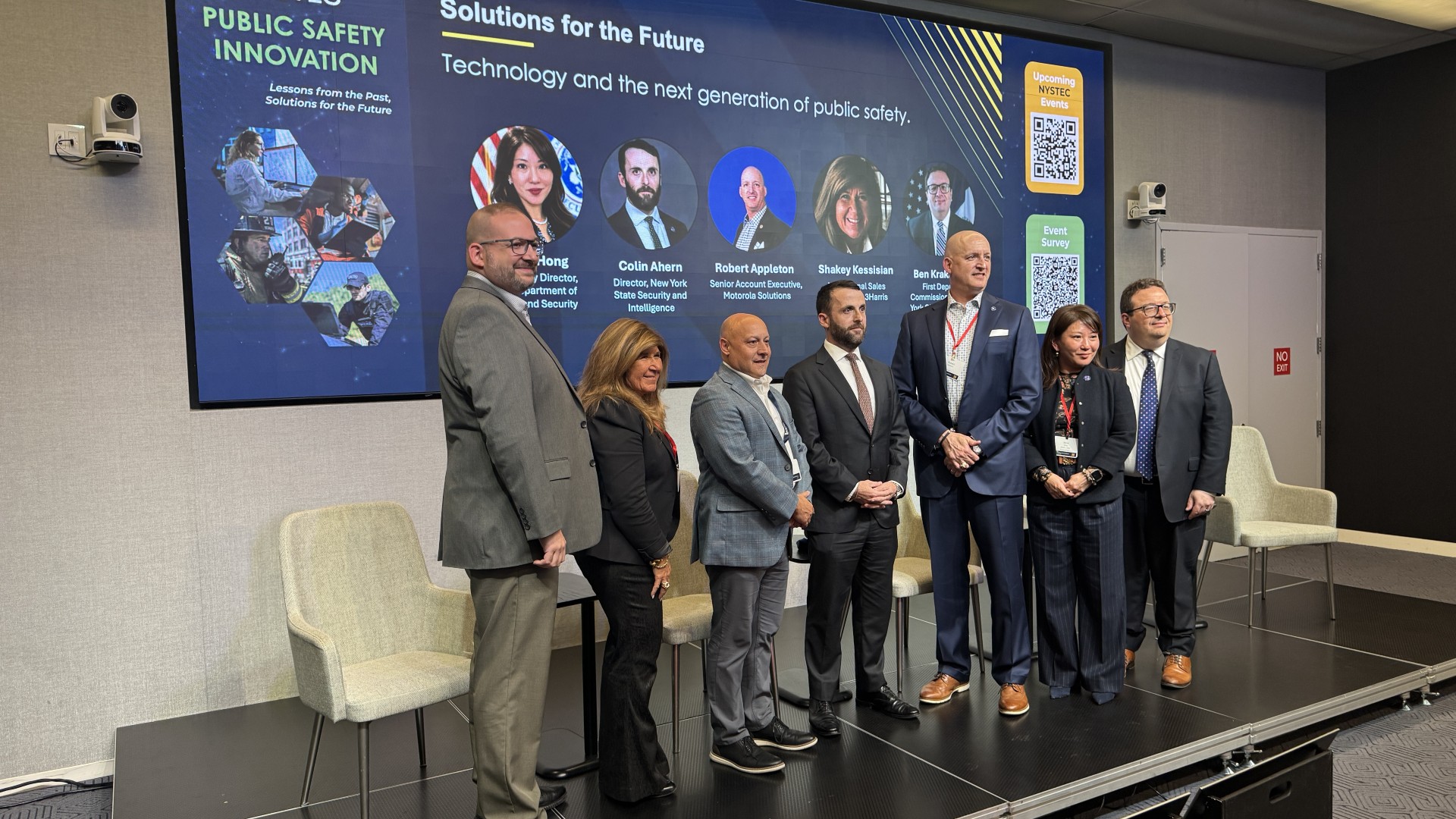
Key lessons from the Public Safety Innovation Conference
This evening I had the pleasure of attending the Public Safety Innovation Conference at Civic Hall in NYC, organised by NYSTEC. It brought together emergency managers, first responders, technology leaders, researchers, and industry innovators around one fundamental question: how do we make public safety technologies more useful, more trusted, and more effective when lives are on the line?
AI, drones, sensors, analytics, and next-generation communications were recurring topics throughout the event. But the most important takeaway wasn't about technology at all — it was about people. Speaker after speaker reminded us that successful innovation begins with understanding operational challenges, building trust, and creating tools that help responders make better decisions under pressure. For Flyhound, many of the conversations reinforced why we built our platform and where public safety technology is headed next.
Technology doesn't solve problems. People do.
One of the strongest messages came from former FDNY Commissioner Laura Kavanagh, who challenged the audience to look beyond the latest technological trend.
“The real solution to all innovation is human, not tech.”
Kavanagh stressed that agencies often focus on acquiring new capabilities when they should first understand the problems they're trying to solve. Her perspective resonated throughout the conference. Whether discussing AI, drones, communications systems, or emergency management platforms, speakers repeatedly emphasised that technology succeeds only when it aligns with operational realities.
For companies like Flyhound, this means spending time with dispatchers, firefighters, officers, emergency managers, and community stakeholders before designing solutions. Build around the mission, not around the technology.
The future is about decision advantage
For years, public safety agencies have focused on improving communications and information sharing. Today's challenge is different.
“The question is no longer how fast can we convene or pass information, but how quickly, accurately, and responsibly can we empower staff to turn that information into decisions?”
Modern emergency operations centres have access to more data than ever: weather sensors, cameras, drones, social media, infrastructure monitoring, cellular and geospatial information, and AI-powered analytics. The challenge is no longer collecting information — it's identifying what matters.
A recurring theme across both panels was interoperability. Historically, interoperability meant making sure one radio could talk to another. Today's definition is much broader: agencies, private-sector partners, infrastructure operators, and communities must share information effectively and coordinate their response. And it extends well beyond communications into emergency management, cybersecurity, critical infrastructure, public warning systems, drones, sensor networks, and AI-enabled decision support.
Leaders increasingly recognise that no single organisation owns the entire operational environment; success depends on partnerships. Flyhound practises this deliberately — we ensure our data is digestible through multiple incident management platforms, so whichever system a municipality uses, it can process our data in real time alongside any other pertinent information stakeholders need.
Trust is becoming critical infrastructure
One of the most thought-provoking moments came during a discussion about emergency communications: the observation that 'not everyone trusts government, and we are not always the best messenger.' That highlights an often-overlooked reality — emergency alerts, evacuation notices, and public safety warnings are only effective if people trust the information they receive.
Several speakers discussed the growing importance of nonprofits, community groups, and local partners that can amplify trusted information during emergencies. Technology can deliver a message instantly; trust determines whether people act on it. The same principle applies to the tools themselves: agencies must trust what they use, understand how decisions are generated, and feel confident the systems will perform reliably under stress.
Simplicity wins
Among the most practical lessons came from veteran emergency services leaders who emphasised usability. A responder operating at 2:00 a.m. during an active emergency doesn't have time to navigate complicated menus or troubleshoot software. Sophisticated technology that's difficult to use often ends up sitting on a shelf. The best tools are the ones that disappear into the workflow.
The growing role of drones and sensors
As you might expect coming from me, drone technology featured prominently. Panelists discussed how unmanned systems are becoming a critical component of situational awareness, helping agencies collect information faster while reducing risk to personnel. Perhaps more importantly, they highlighted the evolution of drones from standalone aircraft into connected sensing platforms.
The future isn't simply about putting more drones in the air — it's about integrating information from multiple sensors and presenting responders with a common operating picture. That vision aligns closely with where Flyhound sits in the public safety ecosystem.
Where Flyhound fits
Many of the conference discussions reflected challenges Flyhound is working to solve today. Cameras and thermal sensors provide valuable information, but cellular signals represent an additional layer of situational awareness that often remains invisible to responders.
Flyhound's mission is simple: turn cellular activity into actionable location intelligence. Whether supporting search and rescue, missing person investigations, disaster response, suspect location operations, or emerging correctional-facility applications, the objective is to help responders find people faster and make better decisions with greater confidence.
Two themes we heard repeatedly — reducing cognitive load and accelerating decision-making — are reflected in our product design. Rather than overwhelming users with complex RF data, Flyhound delivers usable information quickly and simply.
Another theme centred on democratising advanced capabilities. Technologies for locating mobile devices have historically been expensive, specialised, and available only to large federal agencies. Flyhound's goal is to make advanced location intelligence accessible to state, county, and local agencies that may never have had it before. In many ways, that mirrors the broader mission of public safety innovation itself: bringing powerful tools to the people who need them most.
Looking ahead
If there was one overarching lesson, it's this: the future of public safety isn't about collecting more data — it's about helping people make better decisions.
The technologies discussed throughout the event — AI, drones, satellite communications, advanced analytics, next-generation sensors — will undoubtedly transform how agencies operate. But the organisations that succeed will be the ones that focus on human-centred design, trust, interoperability, simplicity, and operational effectiveness. Those that identify these challenges and solve them thoughtfully will define the next generation of public safety.
At Flyhound, we're excited to be part of that future.