Sometime around 27 October — assuming the Bloomberg reports hold — Apple is expected to take the stage (well, the pre-recorded video presentation) and introduce the first touchscreen MacBook Pro. 14 inch and 16 inch models, OLED panels, lighter bodies, a Dynamic Island where the notch used to be. The coverage has the breathless tone of a genuinely historic moment: after decades of insisting that touchscreens on laptops were an abomination against industrial design, Apple has apparently seen the light.
I'd like to extend a warm welcome, fifteen years late.
I've been working on a touchscreen computer — with embedded cellular connectivity, no less — since roughly 2011. My current daily driver is a Microsoft Surface Pro (13 inch, 11th Edition) with 5G, and I'll be blunt: it — and each of its predecessors — have been one of the single most important tools I've ever owned, both personally and professionally. Not because it's flashy. Because it disappears. It gets work done wherever I happen to be standing, and for someone who runs a startup in drone technology, "wherever I happen to be standing" is a genuinely wild variable.
The part nobody talks about: the connection
The touchscreen is the headline grabber, but the feature that quietly changed my life is the modem baked into the machine. Embedded cellular means I'm not dependent on café Wi-Fi, hotel networks that demand my blood type, or the mercy of whatever hotspot my phone deigns to share before cooking its battery. The Surface Pro with 5G connects itself, everywhere, and stays connected.
If you've never worked this way, it's difficult to overstate how much cognitive overhead it removes. There is no ritual of "finding somewhere with good internet." There is only somewhere. The list of places becomes effectively infinite.
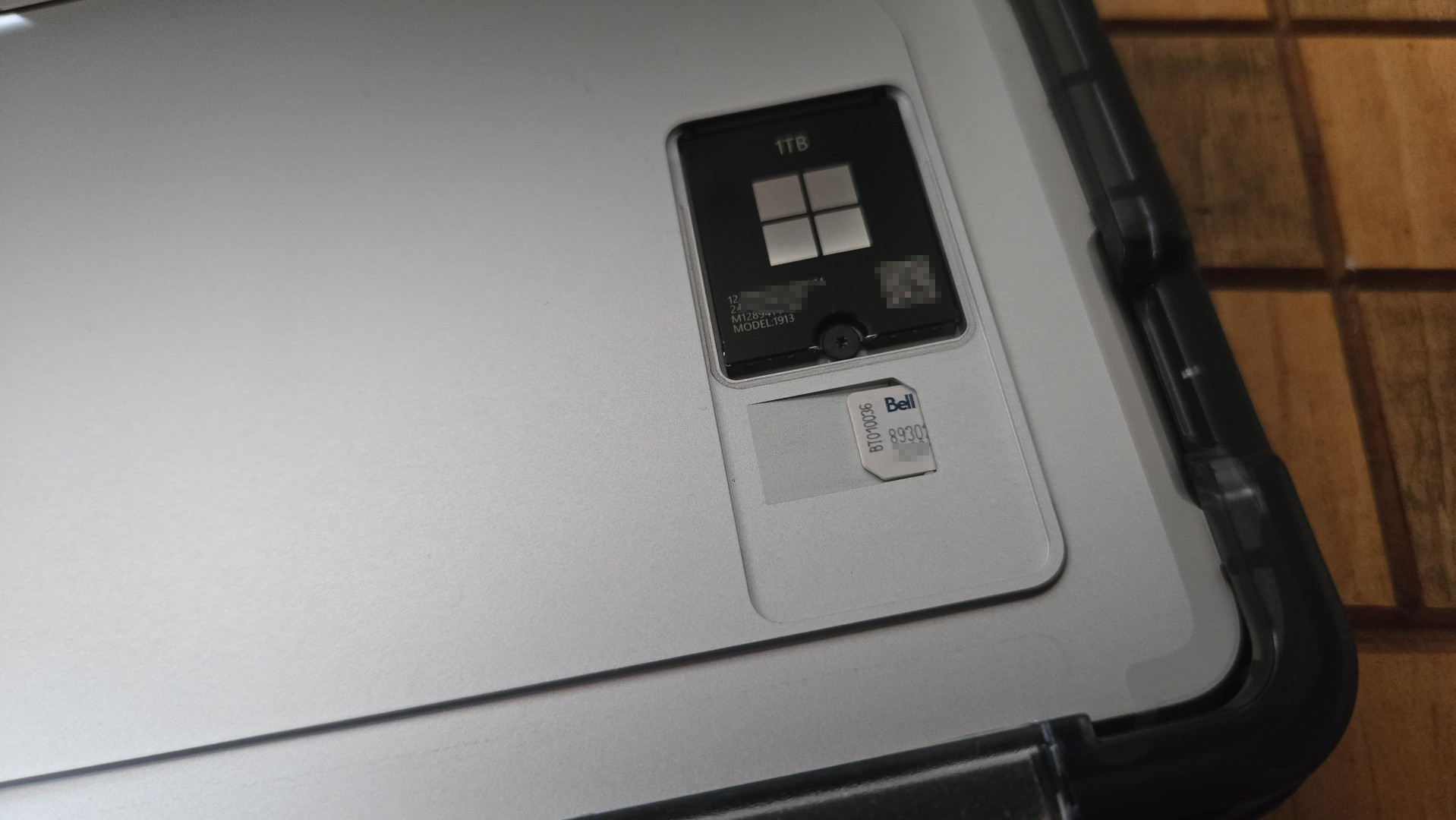
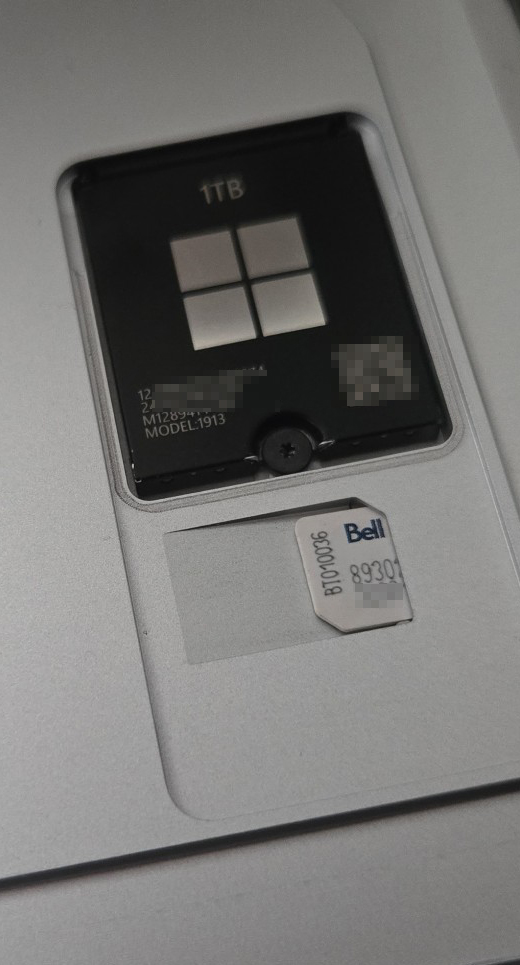
And the thing that powers it all? This tiny little micro SIM card, the same that you might find in a smartphone before eSIMs became the norm (which, by the way, the Surface supports). Which brings me to the fun part.
Where I've actually worked from
The back of a van at a flight-test site. When we're out doing drone operations for public safety work, there's rarely an office nearby. Tablet mode, pen in hand, filling in compliance paperwork and sketching flight geometries directly onto the screen while sitting on a tailgate. Try that with a clamshell.
A train somewhere in the wilds of the Northeast Corridor. Amtrak Wi-Fi being what it is, embedded 5G means I've had conversations, reviewed contracts, and marked up schematics between New York, D.C., Syracuse, Toronto, and Montreal. The pen annotation on a touchscreen is criminally underrated — red-lining a supplier agreement with an actual stylus feels like working on paper, except the paper files itself.
Parked on the side of the road, seatbelt still on. One of the greatest features in video calls today are virtual backgrounds. I can't count the amount of times I've been in a car — on my way to or from some customer meeting, startup event, or simply running errands — when I needed to take an important call. My virtual background? A 12-second repeating video in our office and only a few people have noticed.
A slippery gravel road on the side of a mountain in Costa Rica. I once made the mistake of booking a long-term house rental in the mountains of rural Costa Rica that advertised “strong Wi-Fi.” The only thing strong about it was the headache it gave me trying to do work. With manufacturing partners in Hungary, I've spent my share of mornings doing schematics review and PCB design over strong coffee. The machine just works. Nobody around me has any idea I'm untangling tri-party logistics across three continents.
Airport lounges, obviously. The classic. But also aeroplane stairs, gate areas, and once, memorably, the floor of a terminal during a delayed connection — kicking off a documentary review in tablet mode with my knees as a desk.
My kitchen table at 6 a.m. Not glamorous, but with an Italian co-founder who is sometimes in Italy, the ability to detach the keyboard, flip to tablet, and have a quick video strategy session whilst eating a hard-boiled egg one-handed is a small daily luxury.
A park bench in Jersey, taking a call with a supplier 7,000 kilometres away. It’s nearly logistically impossible to do drone testing within the bounds of New York City, so we’re often across the river in N.J. where the drone laws are more forgiving to what we do. I could have left testing to sit in a coffee shop, but I didn’t. Why? Because I could. That's the whole point.
What Apple will get right — and what they'll gloss over
To be fair, when Apple finally does something, they tend to do it properly. The OLED panels will be gorgeous, and years of iPad engineering mean the touch software will doubtless be polished beyond anything Windows has managed. But here's the thing I'll be watching for: does the rumoured MacBook include cellular? Because the reports, so far as I've seen, are silent on that front. And if it ships Wi-Fi only, Apple will have built a beautiful answer to half the question. The touchscreen was never the revolutionary bit for me. The revolution was being genuinely untethered — no dongles, no hotspots, no "is the Wi-Fi decent here?" The two features together are what turned my computer into a tool that goes where I go.
Microsoft quietly understood this years ago. The tech press largely shrugged. Apple will announce the touchscreen portion of the equation to thunderous applause later this month, and the usual suspects will declare the convertible form factor finally "legitimised." Meanwhile those of us who've been getting real work done on these machines for a decade and a half will raise a mild eyebrow, tap out a congratulatory note — with a stylus, naturally — and get back to it.
Because somewhere there's a factory floor, a train carriage, or a café with terrible Wi-Fi, and work doesn't wait for a keynote.