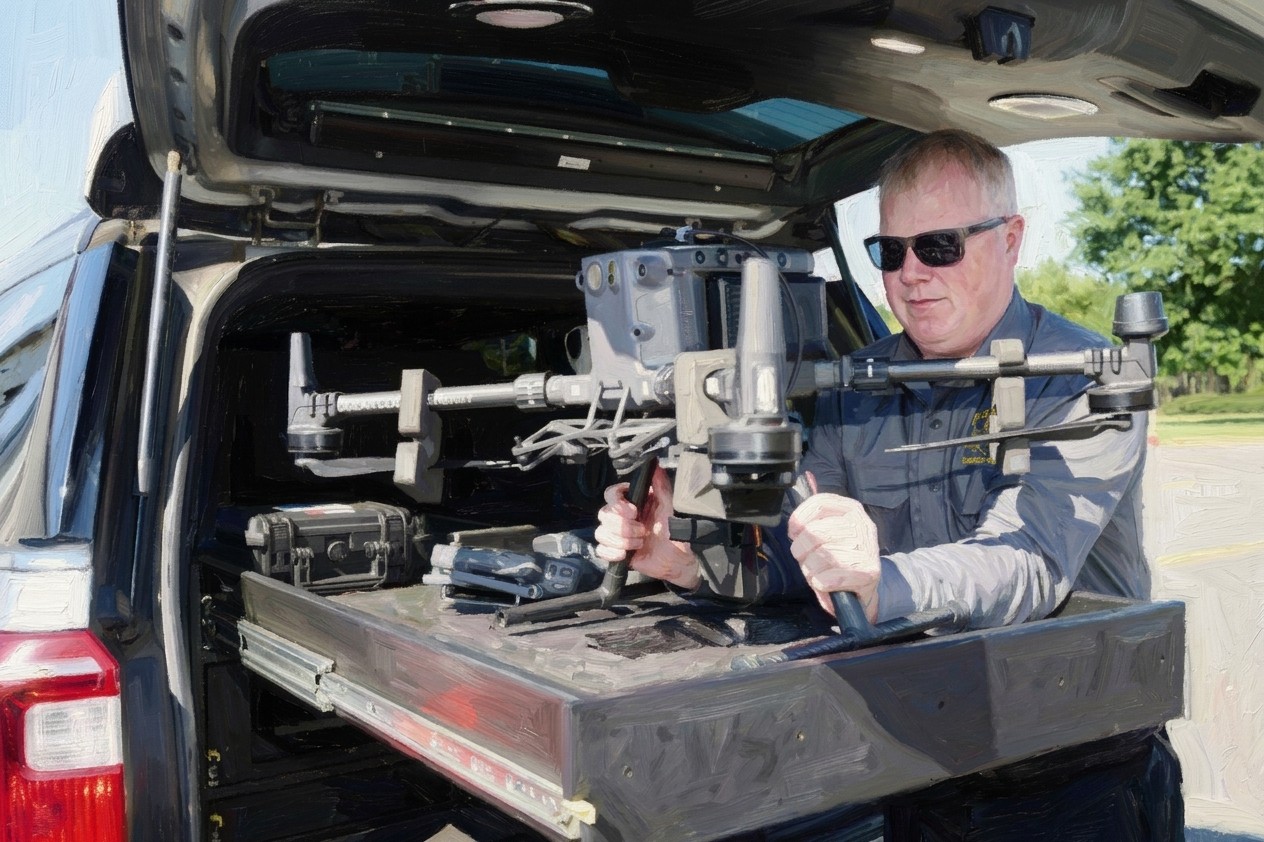
“We have to be cost-effective. And to do that, get the best product that's available to us.”
An NPR report from 12 October highlights a tension playing out across American communities: the push to eliminate foreign-made drones from public safety work versus the budget realities facing local agencies. Front and centre in the piece is Ocean County, New Jersey.
Flyhound got its roots in New York City and Ocean County sits roughly a couple of hours outside Manhattan, and its challenges are representative of hundreds of counties nationwide. When we discuss drone policy, it's worth grounding ourselves in what that geography actually means for the agencies involved.
The numbers tell part of the story
According to the reporting, Ocean County's entire drone fleet comes from DJI, the Chinese manufacturer that is behind more than half of the public safety drone market in the U.S. Their equipment breakdown reads like a procurement spreadsheet that any small department would recognise:
DJI Matrice 300 RTK: $13,699
Two batteries: $1,400
Infrared thermal camera: $11,499
Advanced remote controller: $1,600
Compare that to American-made alternatives offering similar capabilities. NPR noted the Inspired Flight IF800 TOMCAT retails for $21,000, while other domestic options range between $20,000 and $50,000 depending on configuration. That's not an incremental difference—it's often the difference between acquiring one system or five.
When states like Florida, Texas, Mississippi, and Tennessee passed bans on foreign drone use by public agencies, some departments simply terminated their programs. Tight budgets couldn't absorb the premium for domestic hardware. For volunteer fire departments and smaller sheriff's offices, that's not a strategic decision — it's a capability gap.
National security concerns meet local use cases
Here's where things get complicated. Federal agencies and contractors face restrictions on certain foreign-made drones. The FCC is considering recategorizing thermal-imaging drones as "military grade," which could effectively ban many Chinese models with integrated thermal technology. Tariffs ranging from 15% to 100% have been announced on select foreign-made drones, further increasing acquisition costs.
The stated rationale centres on national security — concerns about supply chain control, data transmission, and China's dominance of the global drone market and raw materials needed to build these systems. These concerns are legitimate and warrant serious consideration at the federal level.
But here's what local agencies report using these tools for: finding lost hikers in the Pinelands. Locating elderly residents with dementia who wander from care facilities. Assisting water rescue teams during swimming season. Searching for pets in wooded areas. Conducting traffic accident documentation.
Ocean County Sheriff's Office describes using thermal imaging primarily to find lost people or pets. The NPR piece includes imagery of DJI drones deployed at the Ocean County Fairgrounds, with the Pinelands stretching behind them. This isn't border security or counterintelligence work. It's community protection.
The disconnect becomes apparent when you examine the use cases. A volunteer fire department in Seaside Heights exploring drones equipped with flotation devices for water rescues has a different risk profile than a federal intelligence contractor. Yet blanket policies often treat them identically.
This doesn't mean security concerns should be dismissed. But it does suggest that policymakers need granularity. A one-size-fits-all approach risks disabling tools that serve public safety without meaningfully addressing the underlying national security calculus.
The payload question: Why agnosticism matters
This brings me to Flyhound's approach — and why it resonates with the challenges agencies face.
Our payload to locate and identify mobile phones is agnostic. It works on both Chinese-made and U.S.-made drone platforms that can support the size and weight of our product. We don't tie our software to a specific hardware manufacturer. We don't require agencies to commit to one ecosystem. We, like our agency partners, focus on what the payload does not which flag flies over the fuselage.
Why does this matter? Because it gives local governments flexibility. An agency can deploy on hardware that fits their budget today while remaining prepared for policy changes tomorrow. They're not locked into a vendor. They're not stranded if regulations shift. And critically, they maintain mission capability regardless of geopolitical headwinds.
From a technical standpoint, the payloads themselves perform similarly whether mounted on a DJI Matrice or an Inspired Flight unit. The range and accuracy we can identify one or many mobile phones, the encrypted data transfer between the drone and its operator, and the result of lives saved are determined by our sensor and processor package, not the airframe. Separating these components allows agencies to optimise for their actual constraints.
This isn't about saying Chinese platforms are superior or inferior to American ones. Both have engineering trade-offs. As NPR's reporting notes, DJI offers high-resolution thermal cameras under $10,000, while American manufacturers sometimes lag on flight-time capabilities and zoom features despite charging premiums. We partner with U.S. drone manufacturer Modovolo as they are building a platform that addresses many of these concerns — high quality, affordable cost, and field reparability that meets and even bests DJI in many ways. Modovolo and other domestic platforms may offer supply chain assurances that justify higher costs for certain applications.
The point is that these are separate decisions. Hardware selection is one question. Payload selection is another. National security policy is a third. Mixing them all together limits options without necessarily improving outcomes.
Looking ahead
Ocean County is monitoring federal actions closely. They're aware their ability to update fleets may be constrained by coming regulatory shifts. That's a reasonable concern for any agency investing in public safety infrastructure.
Flyhound's position is straightforward: we build technology that serves missions, not politics. Our proximity to Ocean County isn't incidental — we understand the operational environment because we're embedded in the same region. We see the same fairgrounds, the same Pinelands, the same coastal communities that depend on effective public safety tools.
Policy debates happen in Washington. Implementation happens in parking lots outside sheriff's offices, in fire station garages, at county fairs. Those implementers need solutions that work within their actual constraints, not idealized scenarios crafted far from the ground truth.
We're not advocating for abandoning security considerations. We're suggesting that security concerns and budget realities can coexist — if the approach allows for nuance. Payload agnosticism is one path forward. It respects legitimate national security questions while enabling local agencies to continue serving their communities with functional, affordable equipment.
That balance matters. Especially when the people counting on those tools aren't thinking about geopolitics. They're thinking about finding a lost child before nightfall. Or locating a swimmer in distress.
For Flyhound, that's what drives our work. Not the origin story of the hardware beneath our payloads — but the outcomes they enable for the communities we serve.
Sources
- NPR article - 12 Oct 2026
- Hero photo of Chief Warrant Officer Kevin Fennessy taken by Albert Yee for NPR